

This article was originally published on Medium.
A critical measure of a product manager’s ability is how good they are at communication. Communication isn’t just imparting information — it’s also about being good at listening. Plenty of product people are great at the first part, but fail at the second, and that can leave the teams around them feeling unheard.
A complaint I often hear from field teams in particular is that they don’t get enough input on the roadmap. This often happens as teams start to get larger, adopt more process, and planning cycles are formalised. I’ve also seen this happen to smaller teams when they are stretched across timezones making alignment more challenging, or when there’s no formal product function or transparent decision-making process on what gets prioritised.
Another more general complaint from teams is when there’s no way to influence the roadmap between planning cycles. Product managers negotiate a delicate balance between predictability and reactivity — they need to stay true to the roadmap that was planned and agreed on, but also be willing to adjusting plans to take into account new information. Staying rigid will result in losing time-sensitive opportunities, but being too reactive will lead to instability and lack of focus with priorities changing all the time.
I wrote about managing this balance at the sprint-level in my post on how engineering teams handle unplanned work, but I haven’t talked about doing this at a higher level, or the decisions that go into the unplanned work that gets prioritised.
Measuring the pulse
When Snyk’s Customer Success and Product teams grew and formalised, we started running a regular “Customer Success Top 10” review where Customer Success shared a list of things they wanted to see in the roadmap, or get an update on the status of. Eventually, the Sales team joined too and gave their own list, and over time, it evolved into a more regular but shorter “Field Priorities Review”, where pre-Sales, post-Sales and Customer Success brought their top requests.
This was one of my favourite meetings because, even though I felt we were doing a good job of collecting feedback, it was really useful to have the commentary of the field teams stepping back and interpreting that firehose of requests. Also, by having all the leads in the same room, they could all see how the prioritisation sausage was made, and understand and align on how their own team’s requests stacked up against others.
The pulse session format
After working with more companies, I’ve adapted that original Field Priorities Review into a boarder form called the Priorities Pulse session. I’ve been suggesting this session to companies that are expanding their teams while aiming to maintain a sense of inclusiveness in decision-making on what projects get prioritised.
To keep it focussed, it’s now reduced down to each team’s top 3. More teams such as Engineering and Design are invited too — not just to share their own priorities, but most importantly so that they’re witness to why a need has become an interruption to the original plan. I’ve also seen some great examples where the Engineering representative has looked at another team’s priority and said “oh, that’ll only take us a few hours, we can schedule it into this sprint”, or offered to hop on a call with a customer to learn more.
Here’s a template deck I’ve created to help you run your own session.
I recommend running this session every two weeks to stay responsive — or weekly if it feels necessary. If you do sprint planning sessions, ideally schedule it right before that. Invite a representative from each department — they don’t need to be the most senior person, just someone who can gather the needs from their team and has the context to speak about each chosen item. Ask them to deliver a very short pitch each session of the 3 top things they would choose to prioritise in the roadmap, giving the background behind the need and why it’s in their top 3. If the request’s source is from a customer or prospect, have the representative highlight whether the need is blocking a new deal, renewal, adoption, or expansion. Give them a gold star if they include a list of the customers and the combined deal sizes of these.
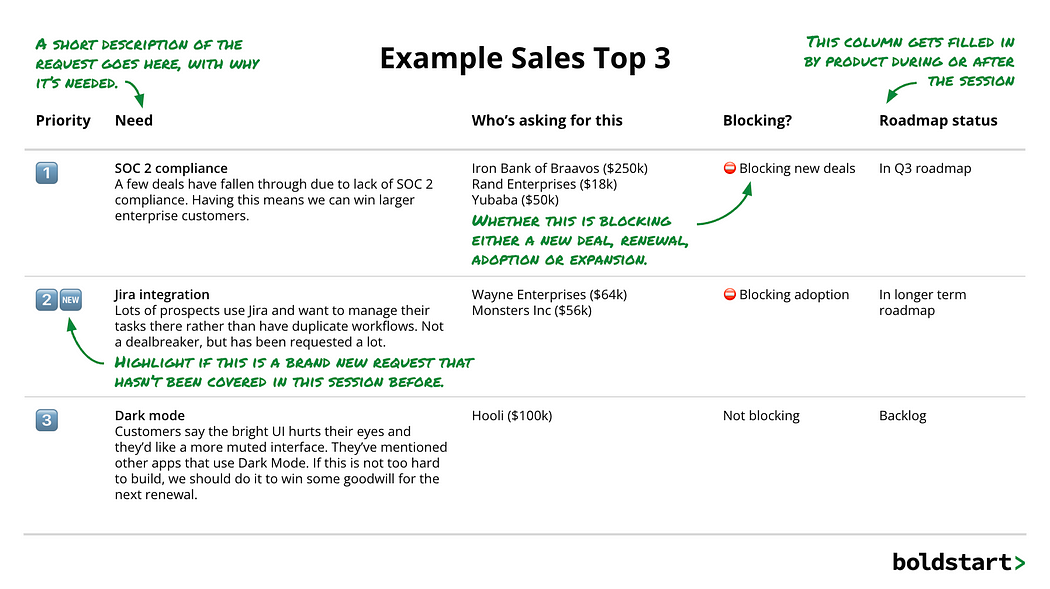
Make sure these representatives are delivering their team’s priorities rather than their own. Ideally you’ll have the same people coming each time for consistency. If that’s not possible, they’ll need to sync with another person beforehand and get briefed on each item.
Keep the session tight — ideally stand-up style, and no longer than 30 minutes. To ensure you don’t run over, have everyone update and review the slides before the session starts. You should only need to cover the changes — things that have been added or changed in priority.
This is a pulse measurement so resist the temptation to debate each item — go deeper 1:1 afterwards on any items that need more discussion.
After the session, pair with engineering to get some rough T-shirt size estimates. See if there are any opportunities in the list that are so low effort they can be delivered quickly with little disruption. Give an update on any items that are being prioritised or any changes that are being made to the planned roadmap. Talk to any team members about requests you don’t fully understand. And reach out to customers and prospects with blocking needs to get more context and understand if there are practical, short-term workarounds you can offer.
Balancing being reactive with being predictable
Although you’re reviewing each need and learning why that team considers it a top need, the purpose of the review session isn’t to react there and then. The goal is for the groups presenting to feel heard, and the product team to get a better understanding of what teams want so that they can make informed decisions about whether they should react. Here’s what I’ll be thinking about with each presented need:
- Do I feel like the person justifying the need has the full context, or should I ask them to go back and gather more information?
- Is there a way to reduce the urgency of this request and make it not blocking, such as a workaround or delivering a small part of the full solution?
- For anything that feels overly reactive: Is this likely to have a higher priority in the next session, or is something new likely to be at the top? Be prepared to challenge the lead if their requests are completely different session to session — there should be some consistency in what they’re asking.
- For anything that’s highlighted as blocking revenue: Is this the only thing that the customer/prospect needs to unblock that revenue, or is it contingent on other things?
- Am I comfortable with where this currently sits on the roadmap or is it obviously more important than what we currently have prioritised? If so, what would we have to say no to in order to make room?
Tips to make this your own
I’ve seen sessions of this type run successfully at several different companies at a range of different stages, and each is managed slightly differently. Some only include field teams, others have a slide for their CEO, some run it weekly, and others fortnightly. It’s always best when it’s designed around how your teams like to work. Here are some possible variations on the approach:
- Although I’ve provided a slide template, you don’t have to run this session as a slide deck — I’ve seen some teams use Notion, Google Doc, or a kanban. Use whatever all the teams are familiar with and comfortable updating.
- Keep it lightweight. This shouldn’t feel like a process with a capital P. I’ve found these work best when they feel more like a check-in than a meeting.
- It’s not uncommon for the CEO to feel like they’re not included in decisions of what gets prioritised, so ask if they’d like to join too. You can also do this if they have a habit of seagulling — this process helps keep them honest as their requests are presented alongside other teams.
- It might feel a bit meta, but it can be useful to present Product’s top 3. You could present this as the current roadmap status, or what you’d like to see prioritised in the next planning cycle. I like to use it to show the top 3 feature requests based on the need weight formula.
- I’m a big fan of automating as much as possible, so if you’re using Slack, set an automatic reminder a day before the session with a link to the document you’ll be reviewing. Tag the owner of each section so they won’t miss the notification.
- You can even run a version of this for customers who have lots of needs. Just be careful, as they can take their top 3 as a signal that these will be prioritised. I used to run regular check-ins with key accounts where we’d review their list of priorities and give them an update on which ones aligned with our plans. These were difficult conversations when something they really wanted wasn’t in our roadmap, or when we’d go a while without delivering anything on their list, but they were appreciative of the transparency and the time we took to understand each request.